Preparation Continues!

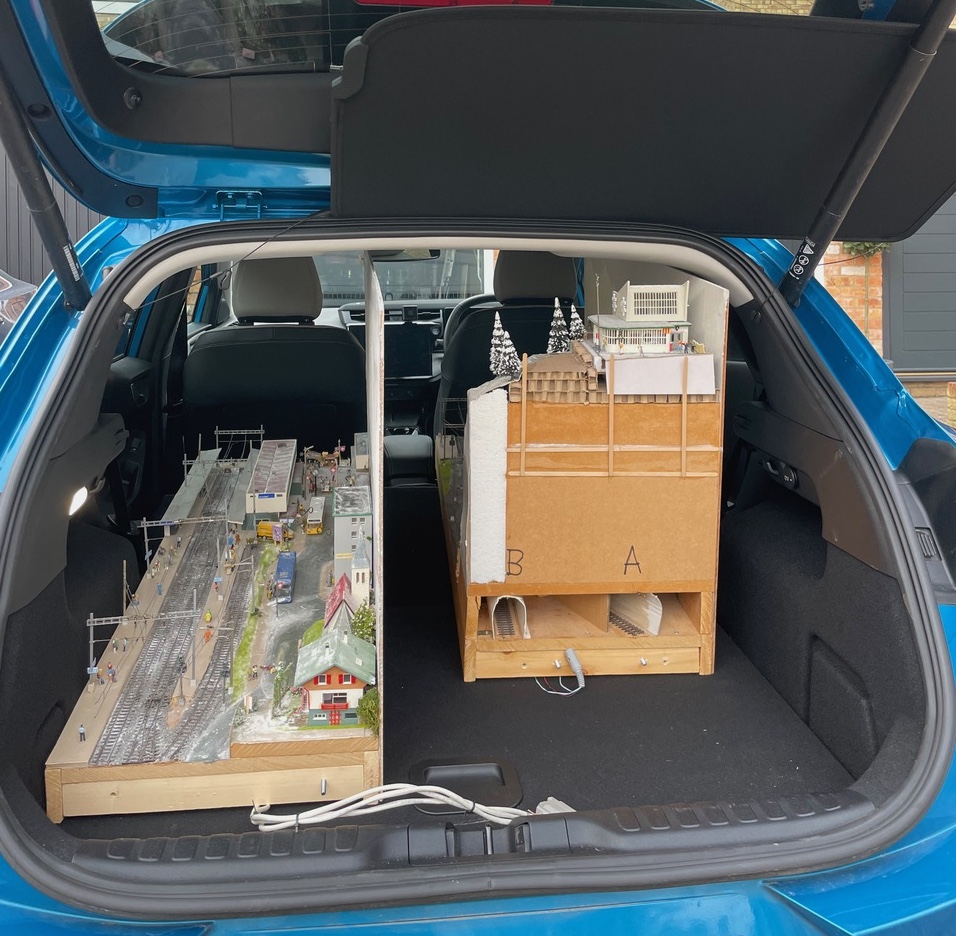
I have offered to show Innsdorf at the Stamford Model Railway Show this May 9th and 10th, organised by the Market Deeping Model Railway Club, and my offer has been accepted, so although the layout is fully operational at home, I now have a number of relatively minor tasks to complete to make it exhibitable. These are now well in hand and I still have four months left – although I know how fast time can pass, especially when I’ve been persuaded to blog abut progress …

Most importantly, I need to complete the fiddle yard. Track has been laid and various experiments have been carried out on dealing with the pantographs as they come off the overhead on entering the hidden sidings and glide back onto the overhead as they return to the visible part of the layout. The final system for the latter will be the subject of the next post. Today I am reporting that I have installed the cable and plug to connect the hidden sidings to the station, a copy of the plug on the mountain section of the layout installed in the railway room at home, and that work continues on painting the background. At the end of the station is a large hotel in traditional Swiss timber style and this has to be very flat indeed in order to fit in at home, so is simply a piece of card stuck to the backscene: very low relief! But it looks OK: do not study closely – well, you can’t study very closely in that location anyway, and there is plenty of other detail to take your attention. It should be fine.

Still to come are a low screen to the front of the fiddle yard, a little attention to the fiddle yard points, a curtain around the bottom of the layout, and brackets for mounting the control panel behind the layout (it is in front of it when installed at home). Then learning to load and unload the car!

Preparing to show the layout in public for the first time is a little scary. It will be the first time I have exhibited (other than club layouts) since 1981 and there are many aspects of this particular layout which are new to me. But it works OK at home, so I am (fairly) confident …

Like all model railways there will be continuing improvements after May, but then I should like to concentrate on building the mountain sections and the third station, a mountain village terminus. Unless I get invited to exhibit elsewhere, of course.

Finally, for now, if you are interested in following my “adventures” on the railways of Switzerland, and the UK and many other European countries, then do subscribe to my weblog www.mwtrips.co.uk and to my YouTube Channel @Marks_Rail_Adventures, where you’ll also find an archive of the videos shown here on innsdorf.com. See you there!

Those Platform Lights

As I mentioned earlier in the year, among the detail kits I bought with money I was given for Christmas last year were five kits for building the distinctive gantry-mounted station lights for two of my stations. I built one fairly soon to test out how easy or difficult it would be (difficult!) but it might be good, if I have enough time, to install three of these at Innsdorf station before it is exhibited. So when I have completed the essential tasks that remain I’ll see about getting the other four made up as a single project, storing two for the eventual Bad Moritz station and installing three at Innsdorf.

Installing these will not be very simple, either! I need to get power up to the gantry with the electrical wiring hidden as well as I can; I don’t want a neat and realistic light fitting fed by obvious overscale leads. But first, I’ll get them made. My inclination then is to solder one of the wire tails to the gantry itself so that I only have one lead to take down to platform level, firmly glued to the back of one of the stanchions, then a terminal block underneath can be wired into the switched lighting circuit that controls the street lighting. It is keeping it all insulated but connected which is the challenge when dealing with such fine wires. And remembering to put the resistor in the circuit before connecting the LED to power!

Almost Ready!

Painting the backscene, with a slight hitch!

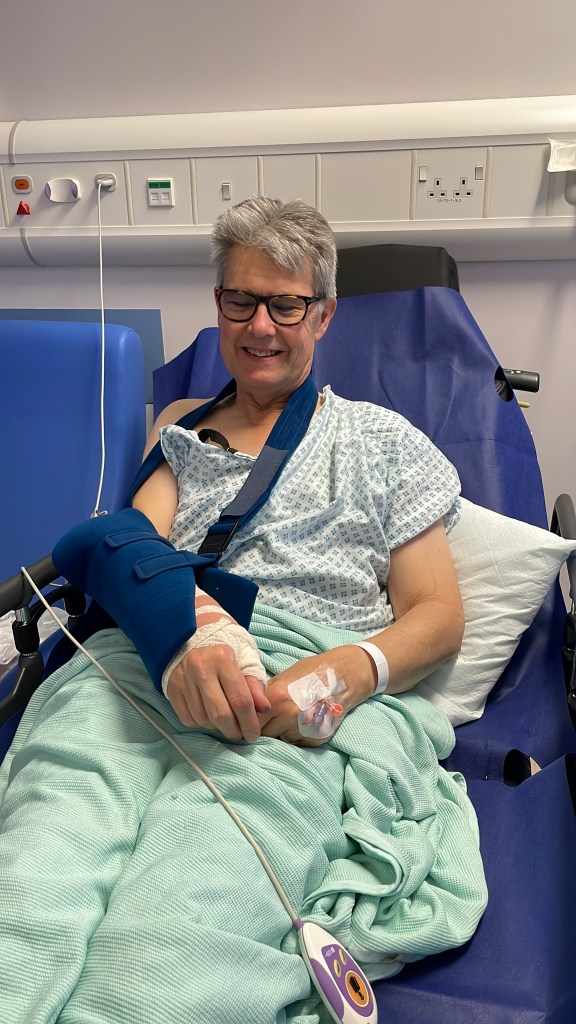
When I was about forty years old and first needed reading glasses, I imagined that deteriorating eyesight would become an increasing difficulty with building scale models, but that has not turned out to be the case. Thirty years on, with spectacles I can see well enough: sometimes working upside down under a layout can be a challenge, and I do need lots of light, but I’m OK. What I had not foreseen was osteoarthritis in my hands. That has become a problem recently, but now a consultant orthopaedic surgeon at Peterborough City Hospital has decided to operate to restore functionality to my thumbs, one at a time. It’s going to be great once they are both done, but … the recovery from the surgery each time takes many weeks, so I am currently living, and modelling, with one arthritic (left) hand and the right one out of service for a while. So painting the backscene is having a little break for the moment!

I had originally thought in terms of a photographic backscene like the one I used on my art deco layout, Burghley Junction, but I soon realised that this would not work with Innsdorf. The mountains were to be distant and shrouded in snow clouds. The only real option was to paint the backscene and try to merge it with the 3D scene in front of it. I had already undercoated the plywood backboards and fixed them in place, so with some white and grey paint I began creating the basic outline of the mountains, and that is as far as I got before travel and then surgery stopped play … but, actually, I am quite happy with it as it is and only hope that when I get back to it I do not spoil what I already have! Difficult one.

Laying Track in the Portable Fiddle Yard

Although I built the legs for the portable section of the layout (Innsdorf station and village) and the board for the fiddle yard, laying of the track had to wait for an opportune moment because I could not do it in the model railway room: it needed a longer space. This meant either outside (in the garage) if and when the weather was suitable, or along the landing when I could be sure of a few days free of grandchildren or other guests and when I had enough time in one chunk to get on with the job! That time had finally come and the track has been laid. The whole portable layout was erected on the landing so that I could line up the fiddle yard track with the track on the station boards. I could also test the stability of the legs for the whole portable section and to do some other jobs which were difficult (some of the scenic work) or impossible (attaching the boards for the back scene) while Innsdorf’s boards were in their place in the railway room.

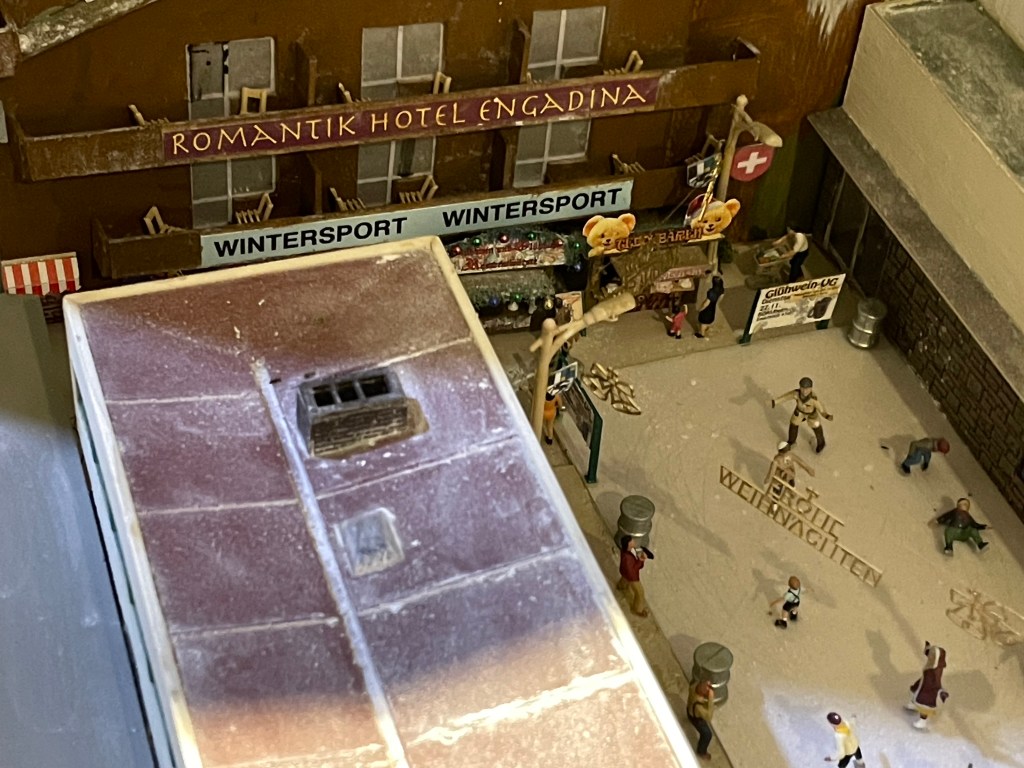
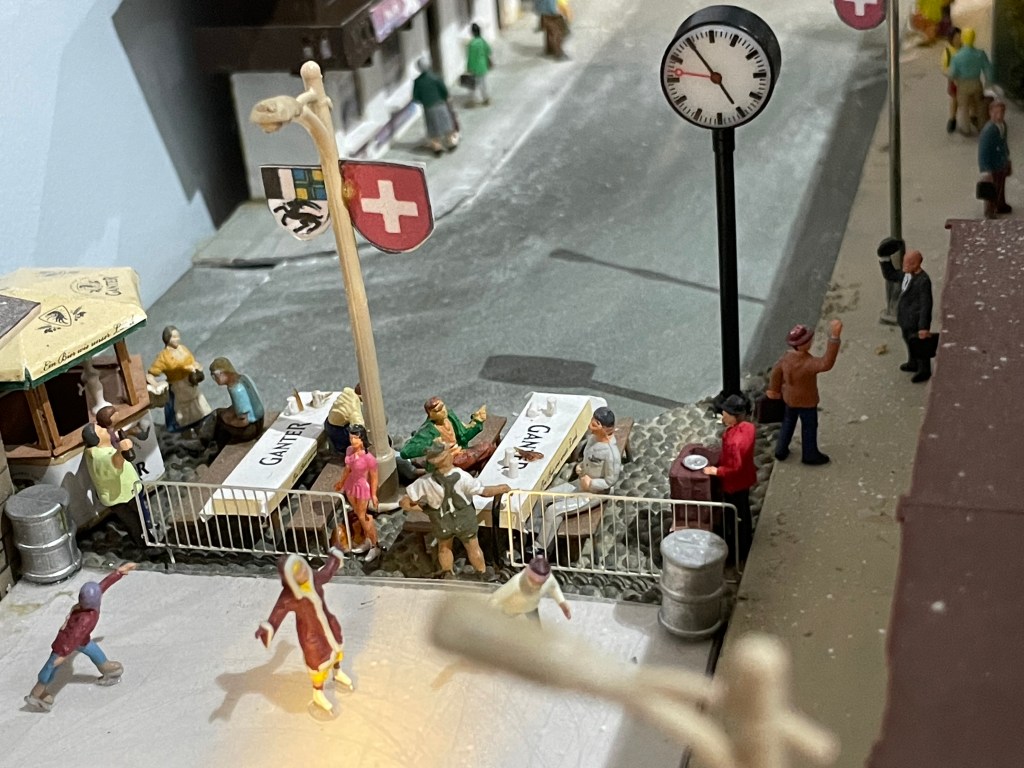
I had acquired some figures courtesy of last year’s Noch Advent Calendar and most of these were installed as part of this project because it was easier to access the ice rink, Christmas market and the station concourse where several of them would be going. I have finally included some passengers with wheeled luggage, a distinctive feature of modern rail transport. It is all beginning to look good now.

I had to buy a little more track and while at Trains 4 U discovered some HO scale street Christmas decorations which were added to the purchase and have really set the scene at the Christmas market and beer festival in the station square. I am very happy with what I now have and feel I am getting there with an exhibitable layout with some interesting detail to hold attention between trains – vital with a terminus layout where one cannot keep trains running continuously. The back scene now needs painting and the track and overhead tweaking (especially where the layout joins the fiddle yard). Looking forward now to moving back onto developing the mountains and the other two permanent stations!

Details, and more details

I was horrified to see that it has been over a year since I last posted anything here. It is not that nothing has been happening but that nothing much has been completed, so although I have been taking photographs and video it never really seemed worth posting them, but I thought that perhaps it might be an idea to compile a report for the blog and let everyone know that Innsdorf is still very much alive.

RhätischeBahn station platform lighting: tiny on HO scale!

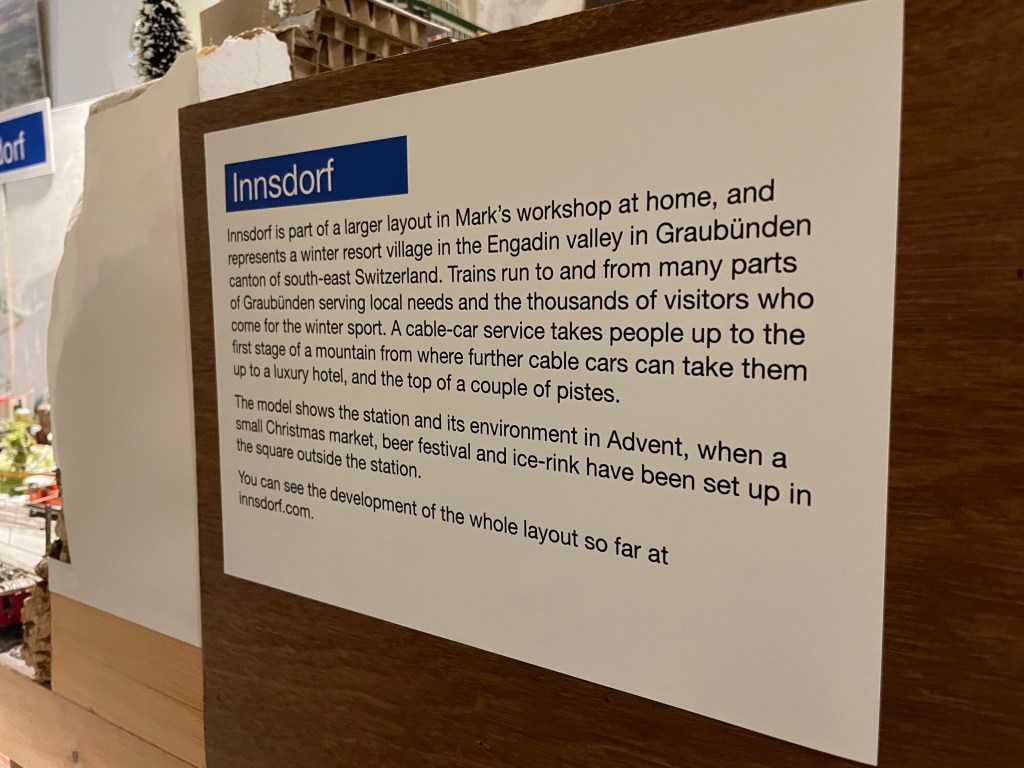
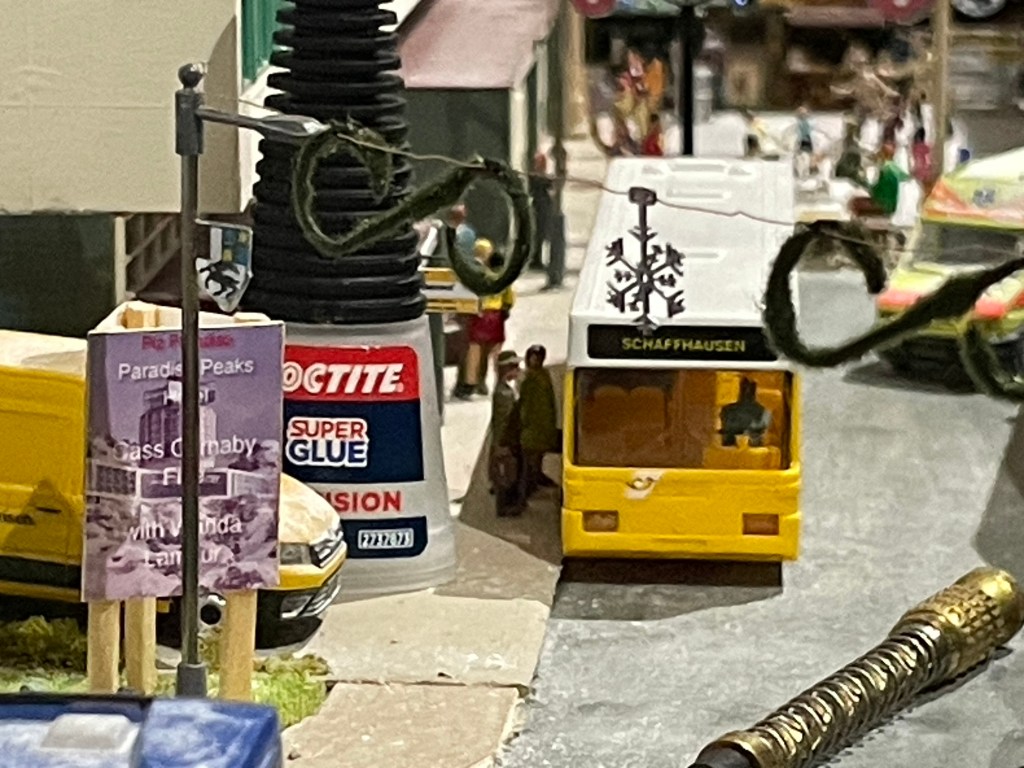
I am now beginning to put in a little more time on railway modelling and progress is therefore accelerating a bit, and over the last few months I have acquired a number of items, mainly detail kits, to add some Swiss authenticity to Innsdorf station and village. I had been turning over in my mind for a couple of years how I might make the distinctive RhB station lighting, mounted on the electrification gantries, and Swiss bus stop signs, both of which would indicate that this is Switzerland, and Graubünden in particular. Then in an issue of Continental Modeller I read of a layout where the station lighting had been bought from the Swiss Model Railway Shop, so I looked at their website and found the lighting I needed, the bus stop signs and lots more detail. The kits are, as you’d expect from something so tiny, extremely difficult to assemble, requiring peace and quiet, lots of light, a steady hand and the right tools, but progress is being made and there is a real sense of satisfaction in getting these things done.

The bus stop signs are already in place now and I have begun the fiddly task of assembling the light fittings – the even more fiddly task of installing them and connecting them up will follow eventually! Meanwhile the only tasks really outstanding before Innsdorf is ready for exhibition are the back scene and tracklaying in the fiddle yard: painting of the back scene has begun, and the fiddle yard board and legs are already complete; the track has been bought.

Human Interest

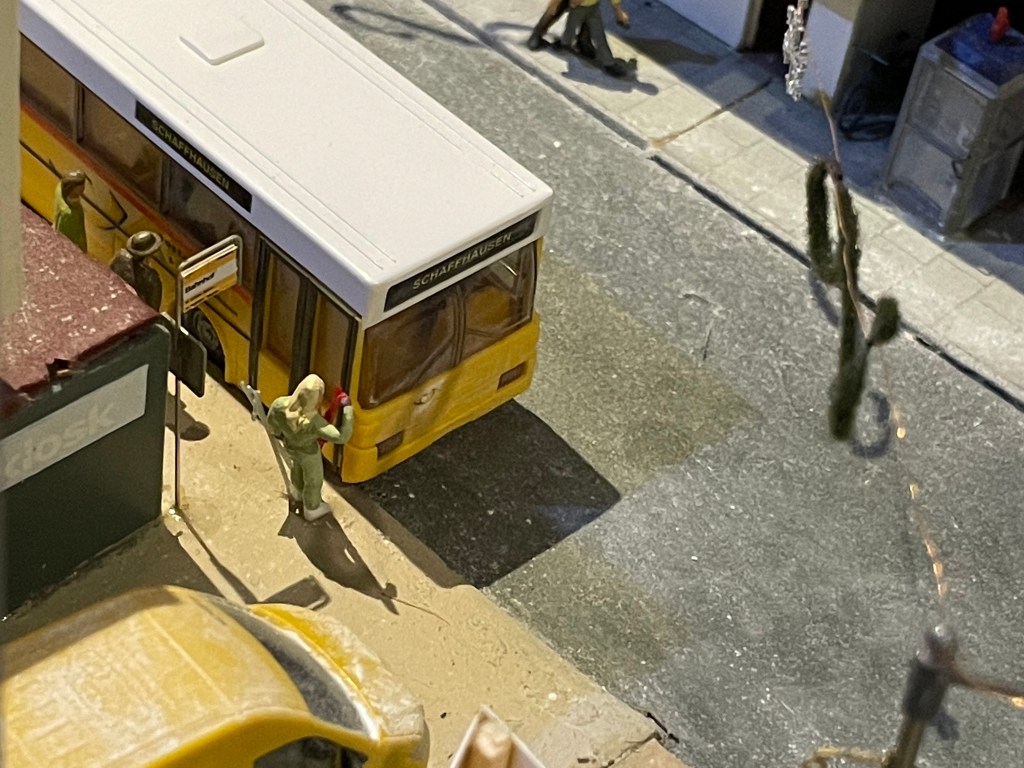
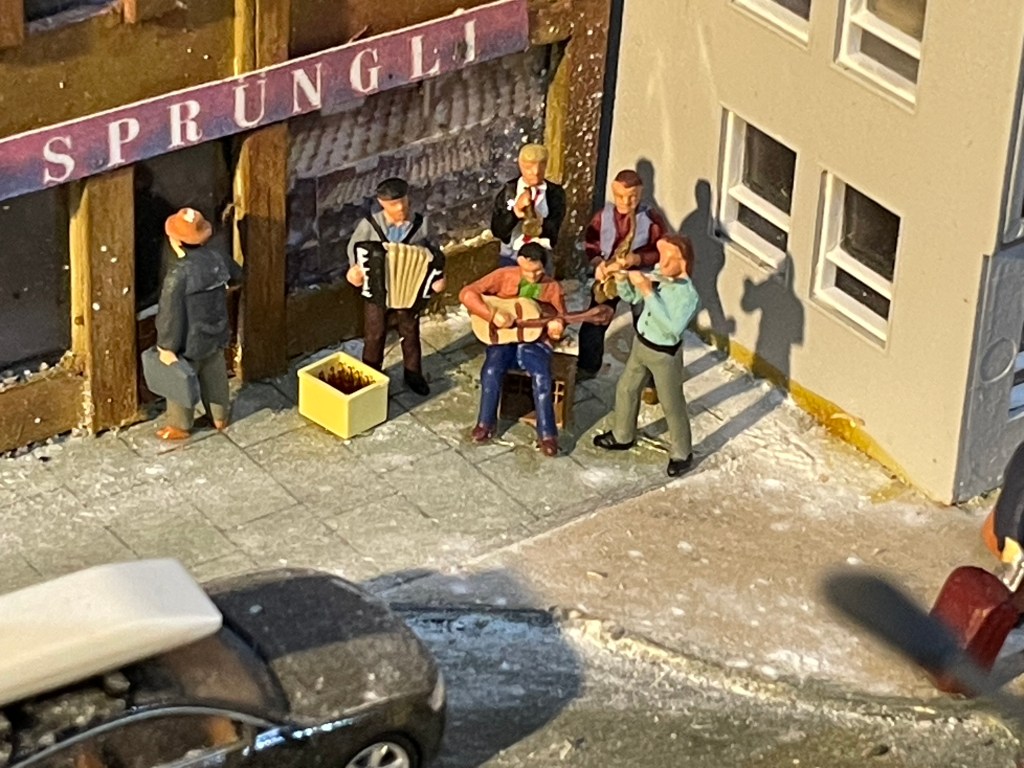
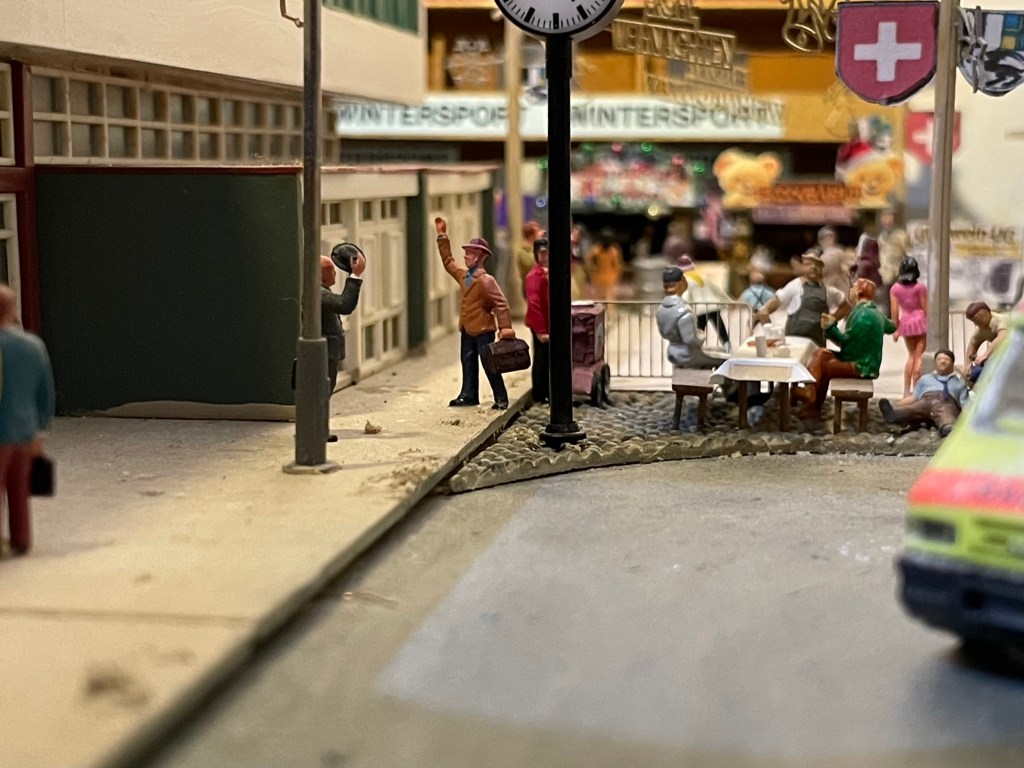
As you may have seen in previous posts, I do like to include interesting “vignettes” of life in my model railway. These days all sorts of sets of model figures are available that allow a huge range of situations to be modelled quite simply (although quite expensively!), but also there are standard ranges of “passengers” and “shopper” that can be placed in interesting ways. I have a bus queue, for example, groups of people with luggage waiting at the station, and people standing at the bar at the beer festival.

For Christmas I was given a simple little set with only one character, a cyclist who had slipped off his bike on the ice, ideal for my model railway. The video shows him being placed, and looks at a few of the other situations.

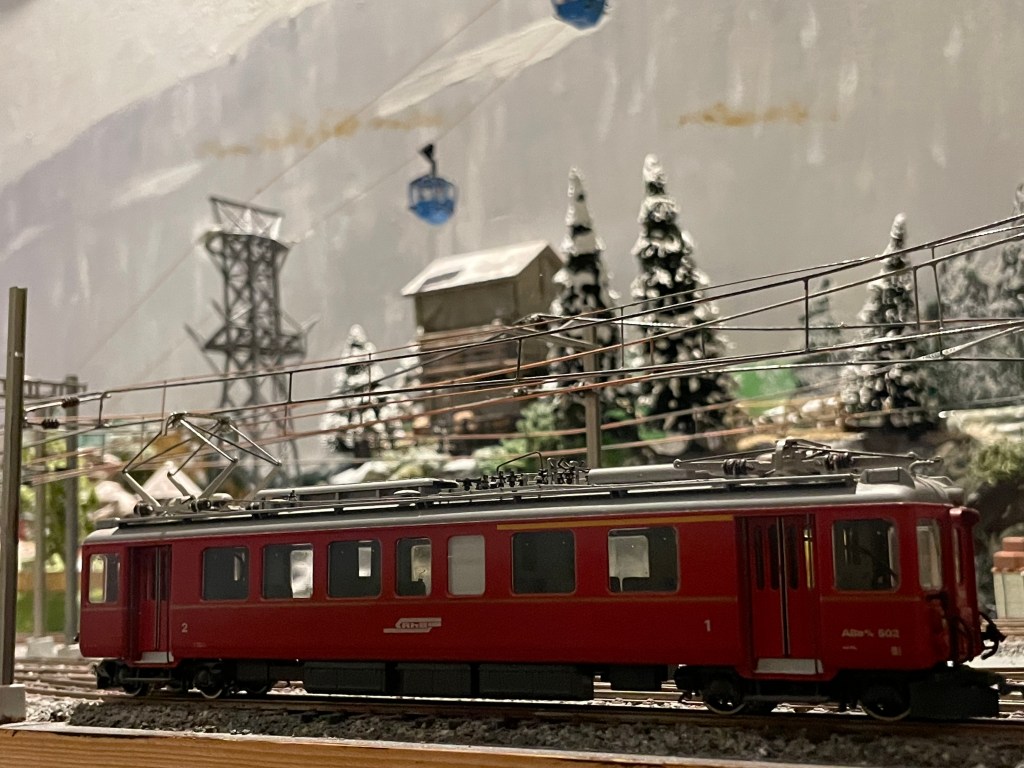
I was also given a large quantity of slightly smaller and less detailed seated figures which I am gradually placing in my coaches to fill them with passengers. I have already dealt with this topic in a previous video, which I copy below for convenience. It is a long job painting the people in more realistic colours and fitting them in the trains, so I am doing it a little at a time and will end up, I hope, with train that look like they are earning their keep!

Preparing Signals; Building a Fiddle Yard

Work continues on controlling the intermediate station (I really must think of a name for it), and I have made considerable progress in preparing the portable section of the layout for exhibition. This involves making removable but stable legs for what it now quite a heavy layout, along with a “fiddle yard” which provides somewhere for the trains to run when away from the permanent part of the layout. I have decided to prioritise this aspect of construction so that I have something to show at exhibitions, although work will continue slowly on the mountain section towards the upper terminus.

Creating the connection between the station and the fiddle yard

I have also acquired the timber for the back scene which will help to create the feel of an alpine resort village, and scenic work on the village continues: I hope all will be ready for showing by next spring. One challenge is that the portable payout cannot be set up in my workshop because there is not enough space for the terminus and fiddle yard, so to work on that as a whole means taking it onto the landing or out into the garage, which is quite a task.

Apology for the Silence

It’s not that I have not been doing anything on Innsdorf, although I must admit I have not been doing as much as during the lockdowns (who would have done?). What I have not done, though, is to finish anything and so I have not really had much to show you.

Snow continues to fall on Innsdorf!

Those who have followed me from the start may have taken in that the station, the two baseboards with which I began and which rest on brackets on the wall of my hobbies room, is intended to be portable, to be taken in due course to model railway exhibitions, whereas the rest of the layout with its mountains and tunnels is fixed into the room. I decided that in order to get an exhibitable layout ready I really needed to create the kit needed to operate the station separately from the fixed section of the layout, and this would mean making legs and a “fiddle yard,” a set of non-scenic sidings which represent the rest of the RhätischeBahn system offstage. I have bought the wood and begun the construction, but I cannot assemble it all in the hobbies room because that is not long enough, so … we wait for the summer weather so that I can set it up outdoors, probably in my garage.

Whoops! There is not enough clearance for the point motor under the point, so I’ll have to place it beside it, on an extra piece of board.

Meanwhile I have continued to develop the intermediate station and its wiring and progress has been slow – I discovered a mistake in my planning which I can easily-enough correct. I do want to get this bit right first time, even if it means that the “first time” is later than we might like!

I have also continued to acquire things as they have become available, such as the rest of the signalling equipment for the layout, some buses (very rare, some of these, and need to be grabbed when they appear) and just one more locomotive and a few more wagons and coaches.

I’ve been taking video of the jobs I’ve been doing and will put something together for the blog as soon as one thing reaches a worthwhile stage!

Controlling the Intermediate Station

The middle station needs no power feed of its own, being powered by the controllers at the two termini (well, just Innsdorf at the moment, but the mountain terminus, Bad Moritz, will have one in due course), but it does need its points and signals to be controlled locally, and I have built a small panel to hold the switches for these.

To operate the points I decided not to use the Hornby/Peco type of motors that I used at Innsdorf which left a big hole under each point that was hard to hide, but rather to use some second-hand Hammant & Morgan motors I happened to have, along with an ancient Tri-ang motor that probably dates from my childhood but still works. The H&M motors are used in the same way that I used when I added electric point operation to Kingsgate: a rod through a small hole in the baseboard between sleepers near the point, with a stiff but springy steel wire soldered into a deep groove in the end of the rod and hooked into the tie-bar of the point – stiff enough to push the point blades across but flexible enough to absorb excess movement. The Trip-and motor is mounted above the board and will be hidden in the scenery.

The track layout at this station is simply two loops off the single track and as the points at each end of each loop will always be changed together there was no complex insulation needed to avoid shorting the live-frog points, and provided I used a capacitor-discharge system to provide the “oomph” I could change both points at once with one momentary contact switch for each loop. These are toggle switches so it is hopefully going to be instinctive to operate … A switch is also provided at each end of the panel for the starter signals.

The power controller that will eventually be used at Bad Moritz, the proposed top station, has a socket for a hand-held second controller and I shall be able to use this in the event that train control is needed at the intermediate station, for shunting, for example, or for running a locomotive round if I decide to terminate trains here for some reason.

There is still much to do here electrically so rather than make you all wait until it’s finished, this video is a bit of an interim report. More to follow when I get a bit further with the project!

Laying Track Through the Mountains

The track base is now complete as far as the intermediate station on the mountain pass line, and slightly beyond, and I have been laying the track and have successfully run trains to and from the station. I had to use flexible track because the fixed-radius curves I have in hand are not small-enough radius to provide the effect I need in the space I have available. It is hard to lay flexible track for such tight curves, but with care it can be done: it tends to tilt and can tip trains off, and it is also not easy to avoid variation in curvature, which can be catastrophic when working so close to the tolerances of the locomotives and rolling stock. I did make a test curve before I designed the layout so I knew that I had some vehicles which could go round these curves successfully, but I also suspected I’d have several that would not and would have to be confined to the other part of the layout!

I drilled the sleepers and pinned the track direct to the MDF which I was using for base: no cork underlay was used on this section because it was all going to be hidden under snow, so the ballast shape did not matter and I felt that with the need for firm track here the trains may just run slightly better on a firmer base. After one of the test runs I did some adjustments to the track where it was joined just outside the intermediate station – the join was not quite straight, only very slightly out – and sometimes caused some vehicles to derail. One railcar in particular was right on the edge of its ability to take the curve and the slightest deviation was enough to allow the flange to climb over the rail!

Now that the track is laid I shall have to install the point motors and wiring, position the tunnel mouths and erect the overhead electrification masts to the open stretches of track. For light relief I can build the station buildings and the road. There is to be a level crossing, and there will be a road winding up the mountain pass. There is also the need to take the line onward to the terminal station higher up the mountains. Once that is done, then completion of the mountain scenery becomes feasible. Exciting!